

Top 5 Hobby Apps for 2026
From tracking your own hobby to finding a group that’s actually still meeting, see how the best five hobby apps stack up.
Looking for a hobby app that fits you? Some help you discover new hobbies, others allow you to meet people with similar interests and can show you hobby groups in your area. Some hobby apps are a hybrid, allowing you to track your individual and group activity. There are some hobby apps that specialize in a single niche, like Strava (running) and GoodReads (books). No matter which one you choose, there’s one feature you might want to look out for: Most hobby apps remember what you did, while far fewer record what you did together.
These hobby apps are not ranked from best to worst but rather by how well they are designed to fit your needs.
| App | Best for | Individual activity tracking | Find people | Find groups | Group activity tracking | Community building |
|---|---|---|---|---|---|---|
| NerdCulture | Finding partners, groups & group-based hobbies | ✓ | ✓ | ✓ | ✓ | ✓ |
| HobbyTwin | Finding hobby partners | ✓ | ✓ | ✓ | Limited | ✓ |
| Hobbee | Discovering hobbies | ✗ | ✓ | Limited | ✗ | Limited |
| HobbyMate | Hobby events/workshops | ✗ | ✓ | ✓ | ✗ | ✓ |
| Hobbyverse | Individual gamified hobby tracking | ✓ | ✓ | ✓ | Limited | ✗ |
Quick takeaways: HobbyTwin offers a solid combination of hobby communities and friend finding. Hobbee offers hobby discovery, community, and some partner-finding capabilities. HobbyMate leans hard toward real-world communities, events, and workshops. Hobbyverse is strongest as a gamified multi-hobby tracker. Nerd Culture offers all of that, plus group activity tracking where group activity exists alongside the user’s activity.
What kind of hobby app do you need?
- Tracking. You want to log what you did, whether that’s running, reading, or playing board games, and see your personal progress over time. Strava, Goodreads, and BoardGameGeek are the go-to choices here.
- Discovery. You don’t know what new passion or hobby you want to try. Hobbee leans in this direction, allowing users to browse categories, tutorials, and community content.
- Match with others. You have a hobby and would like to find others who have the same one. HobbyTwin is focused almost entirely on matching, whereas HobbyMate has both a discovery community and also facilitates real-world events and workshops.
- Find or join groups. You want to find a physical table, club, or team that you can go to rather than be matched 1:1 with someone. Many of these apps do offer this, but Nerd Culture’s community building features help motivate the group to stay active.
- Track an existing hobby group. You are already in a table, club, or team and want to keep track of what the group does, not just what you yourself do. Most of the hobby apps above don’t quite solve this well except Nerd Culture.
Best all-in-one hobby apps
Nerd Culture: Best for finding and building a hobby community
What it does: Find people and groups to play or meet with by hobby then tracks D&D campaigns, running clubs, and rec league seasons at the group level, keeping individual activity recorded underneath them. For example, solo activities like a bike ride get tracked at the individual level, whereas how many miles your biking group rode gets tracked at the group level. Unlike many of the other apps, it gives the group its own activity log, rather than having the group’s history spread across individual members’ activity logs. This helps motivate people to be consistent with their hobby groups
What to know: The group layer only works as intended if several people participate. One person using it by themselves will produce a log for one person. There are also community building features such as events, messaging, discussion, and newsfeed to keep your group engaged with one another.
Built to Keep Your Hobby Group Together
As Seen On:














HobbyTwin: Best for finding others with similar hobbies
What it does: Matching, groups, messaging, events, paid lessons, and individual hobby tracking all rolled into one app.
What to know: The public-facing descriptions talk about tracking your hobby journey and joining groups and events, but don’t really mention any kind of persistent group-level activity log.
Hobbee: Best for discovering new hobbies
What it does: A broad hobby discovery app. Browse hobbies by category, connect with fellow hobbyists, and access resources such as tutorials and guides.
What to know: it’s built more of a directory and community feed than an activity tracking tool, and its public materials don’t detail any kind of group feature.
HobbyMate: Best for hobby events & workshops
What it does: The current product focuses on communities. Features include event creation with built-in ticketing, member management, 0% commission payments, and a marketplace. Hosts also receive analytics. It’s worth noting that a few different platforms share HobbyMate’s name and this mention is about hobbymate.in.
What to know: Public-facing materials do not seem to describe historical group activity as a primary feature for the platform.
Hobbyverse: Best for gamified hobby tracking
What it does: It has true collaboration features between users. Users can view each other’s levels and medals, and they can enter private timed events together.
What to know: It only tracks individual progress. Each user at that board game night has their own XP and levels with no tracking activity measuring whether your whole group is still going.
Finding a hobby group is only half the problem: is it active?
Many hobby apps can help you find out what your interests are. Others can help you locate other people who have the same interests. But the more important question is: are those other people actually participating in the activity?
A group that shows “Berkeley D&D, 23 members” doesn’t tell you very much. “Berkeley D&D, 23 members, 6 active this month, last session 4 days ago, 18 sessions played” tells you whether you should bother going. Member count tells you there’s a community, but activity tells you whether it’s currently alive. Initially, that activity count serves as a signal of viability, useful to the person considering joining. Eventually, it becomes a collective record of the group’s history, which becomes valuable to those currently in it and encourages people to show up consistently.
Find a Hobby Group That Fits Your Schedule
Search and join hobby groups based on day and time of the week, location, play style, and more. Free to list, free to join,

What to look for in a hobby app
Given what you need, consider looking for:
- Hobby support. See if the app supports the hobby you’re looking to participate in. A great running app isn’t going to be helpful for tabletop roleplaying.
- Hobby tracking. Does it track the hobby itself, like tracking runs, or does it log specific instances, like sessions played or games finished for a group?
- Progress. Does the tracking accumulate to show a running total or a single record?
- Local discovery. Can you find out what hobbyists nearby are up to?
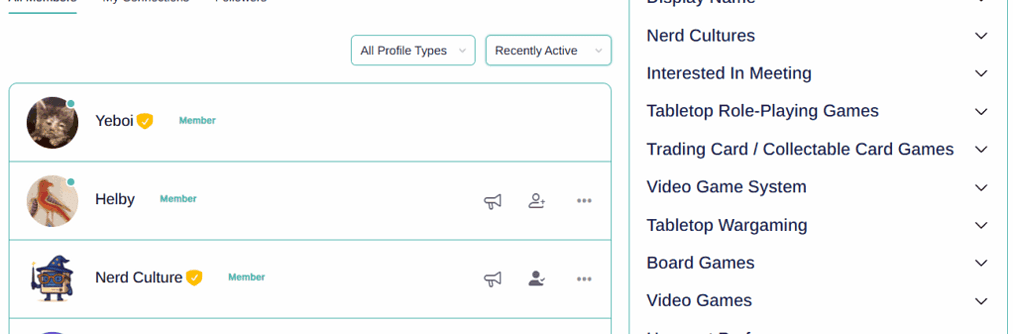
- People search. Are you able to find people in the same hobby, and does the app provide enough information about them (bio, badges, verified, etc.) to allow you to evaluate whether they seem trustworthy before contacting them?
- Groups. Can you find existing clubs that are looking for new members?
- Event scheduling. Can the group use the app to arrange future meetings?
- Messaging. Is messaging within the app supported for contacting a potential match or a group?
- Multi-hobby support. Do you need different apps for different hobbies?
- Group tracking. For a group that already exists, how can you tell whether it’s active or just a zombie group?
Find the Right People for Your Hobby, Not Just Any Match
Filter members by common hobbies, availability, and level. Check our verification features to help make sure you’re connecting to a real person.
Why Nerd Culture approaches this differently
Most hobby apps are very good at answering “what have I done?”. They are a lot less consistent at answering “what have we done?”. This isn’t an argument against individual tracking; a runner should still get their own distance, pace, and PRs. The opportunity is to build on top of that. Imagine a running club where everyone continues to log their run; nothing about that has changed. A runner still has their 6.2 miles, 52 minutes, and 8:23 pace. But since that run was also part of Saturday’s club event, there’s an additional output: 14 runners participated, 81 total miles, the twelfth consecutive Saturday run. Fourteen individual runs didn’t have to stay as 14 separate things, they can be one group accomplishment, too.
It’s not about ranking anyone, but it is about whether the group is still making progress.
- Before joining: is proof that the group is active.
- While participating: is evidence of progress.
- Later: becomes a lasting record of what the group did.
That’s the space Nerd Culture’s group model was built for. A group’s accomplishments are tracked at the group level instead of being recreated based on who’s keeping unofficial records that week.
Nerd Culture didn’t build its group model off of a whim. When the founders were considering how group tracking and gamification would work in Nerd Culture, they looked into research on how people behave when progress is owned by a team rather than an individual. A 2016 factorial study in JMIR mHealth and uHealth found that participants assigned to teams were 66% more likely to continue using the intervention than those tracking individually. While this doesn’t mean that a shared progress bar will keep a hobby group together, it did inform our choice to tie individual participation to something a group could achieve collectively. Research on collective psychological ownership was also taken into consideration here, specifically regarding the difference between something that feels like ours versus something that feels like mine. That’s why Nerd Culture’s group tracking focuses on what the group achieves together, rather than simply ranking individuals against each other.
Your Next Hobby Group is Waiting For You
About the Author
Steven Weingarth (aka ShibaSteve) is co-founder and CEO of Nerd Culture. Between D&D, board games, science fiction novels, and his dogs, Steven has never been short on hobbies. What he could never find was an app that actually tracked his groups, not just his own activity, and helped them stay together over time. He’s tested a plethora of different hobby apps, and kept hitting the same gap. That’s what led him and his co-founder to build Nerd Culture.
Content last updated: September 1st, 2026