



Building an Online Community: Complete Guide
Most online communities fail before they find their footing. This guide covers how to build an online community the right way, from locking in your purpose to engagement strategies that keep it growing long after launch.
A great community is defined by one quality above all else: genuine care for the thing at the center of it. Maybe that something is a board game night that’s become the highlight of your week, a fandom that’s hard for you to explain to anyone who doesn’t initially get it, or a hobby you’d talk about for hours if anyone would give you the time of day.
With the speed of news and trends today, communities come and go in the blink of an eye. Unsurprisingly, online communities built around a moment rather than a sustained interest tend to not outlast their 10 minutes of fame. The ones that endure and continue to grow are built on a strong foundation of passionate people who want to share and be a part of something they actually care about. In this guide, we’ll walk you through how to build an online community that lasts. We’ll start by figuring out what the purpose of your community is, where the right place to build it is, and finally what to do to keep it alive especially when things go quiet.
What is an Online Community?
An online community is anywhere people connect digitally over a shared interest. The platform, whether that’s Discord, Reddit, or somewhere else, is just the space where it happens. The community is what people build together once they’re there. Most general audiences stay passive, scrolling and reading without ever really engaging with anyone else. What separates a real community from that is a shared purpose. People show up because they actually want to take part and contribute, and over time that’s what makes them feel like they belong. Members chat, create, and share their own content with each other, and those everyday exchanges are what forms something that lasts longer than the average comment section.
These conversations happen organically, shaping the community’s culture as the founder and moderators keep an eye on things. As the group grows through invites and through word of mouth, interactions will begin to occur member-to-member rather than running through its initial organizers.
Why Building an Online Community Matters
Online communities matter because finding the right people gets a lot easier in a consolidated space. You can connect with others who share your interest regardless of where they live, which matters more if there’s nobody around you who’s into the same thing. Sometimes, it’ll actually help you meet people who end up being local to you whom you never would have interacted with otherwise. Online communities are also often the best place to start when you want to pick up a new hobby, learning from others who’ve already been doing it for a while or even seeing what the culture has to offer.
Sometimes, an online community may not have the largest user base or highest amount of traffic, but that can be a good thing. A small, active community where people know each other will do more for you than a massive one where nobody notices if you show up or not. Depth of engagement matters more than headcount and a community only works once you actually feel like you belong there.
Types of Online Communities
The type of community you build will shape everything from the content people share to how they interact with each other. Identifying what type of community you’re building will help you make the right calls early and will give you a clearer picture of what your members will actually need from the space.
Online communities will often be:
- Interest-based. Dedicated to a single shared topic. Members share news, react to what’s happening, and find plenty to celebrate and debate along the way. These tend to be broad, often spawning smaller sub-communities around the more specific parts of the interest.
- Creator-led. Built around a specific person or collective. The creator’s output drives the conversation, with members reacting to new releases, discussing the work, and building on each other’s ideas.
- Skill & Learning-based. The goal is to get better at something. Members share progress, exchange tips, and hold each other accountable. Some can be meritocratic in nature, with a steeper learning curve for newcomers.
- Knowledge/Q&A. Answering specific questions is the entire point. Someone posts a problem and someone who’s already run into it provides an answer. More complex or newer problems can lead to larger discussions.
Not all online communities will fit into one of these categories exactly. The broader the subject matter, the wider the net will be. More specific topics will fall under what we call “niche communities.” Since they are underrepresented, niche communities provide great opportunities for you to build a space that others may not even know they need yet. Now that we have a sense of what an online community is, it’s time to jump into how to create an online community.
Planing Your Online Community
When starting an online community, the practical steps involved aren’t all that complicated. The real difficulty lies in creating a place that feels genuine and not just an obvious attempt to grow an audience for commercial purposes. Whatever the unifying topic may be, your goal from the start should be to create a community that you yourself would want to join. If you wouldn’t want to be part of it, why would others?
Find your purpose
Before you begin inviting everyone you know to check out your community, ask yourself an important question: why does this community need to exist? Are you filling a niche that hasn’t found its home yet? Or are you offering an alternative to an existing group? You don’t need to draw up a mission statement chock full of buzzwords like ‘underrated’ or ‘essential’, but it does help to have a firm idea of what you’re offering and why it’ll draw people to your community.
Remember, the more specific your purpose, the easier it is for people to recognize that your community is a place for them. People are more likely to jump in when they can visualize the direction and see tangible progress.
Think about people, not numbers.
Communities are first and foremost about their members. Plenty of guides focus on figures and scale, but a group of twenty active users who engage in meaningful discussion threads and share their thoughts on relevant news is worth more than hundreds of passive members who join and never interact. Your first moves when starting a community should be focused on these specific users. Where do they spend their time? What do they like discussing? What would a community that they would call ‘home-base’ look like?
Choose a platform that fits the community
Once you’ve solidified your vision, start thinking about your platform. Where you settle will depend on your goals and subject matter. For example, video game communities tend to meet on Discord because conversations are fast and happen in real-time. Members can seamlessly go from texting to voice chat and topics are segmented to separate channels so they know where to go if they want to talk about something specific. Conversely, a community that depends on in-depth conversation and advice might be better on a slower-paced, more cerebral platform like Reddit. Threads are easier to navigate and archives can provide answers or discussions that users were thinking about.
Going back to our previous point, consider what your members would want. Choose a platform that fits how your members would naturally want to interact and communicate. If you’re unsure which platform is the right one for you, don’t worry, we have some recommendations later in this article.
Your Hub for Building an Online Community
As Seen On:















Open by encouraging participation
Unfortunately, members won’t stick around just because they’re interested in the topic. They need to see and experience content and interactions that they won’t get anywhere else, and in a young community, it often falls on the community founder to get that ball rolling. What do you want your members to do in your community? If it’s sharing their work, discussing the news, or offering advice, encourage it by setting the example yourself. Once they start contributing, they’ll have a reason to come back to see what others think.
Establish culture early
Culture can quickly take on a life of its own especially in online communities. Your job as the founder is to set an example for others to follow by modeling good behavior and interacting in ways that are hospitable, light, and respectful. Too many communities fall off early due to gatekeeping and toxic behavior, especially from those whom members are meant to trust as leaders of the space.
You can and should set hard rules on harassment and hate speech, but a long list of restrictions can deter newcomers from establishing themselves. As long as you’re present, welcome new members, and step in when things get heated, members will begin to pick up on expected social cues, and your culture will begin to enforce itself.
When starting your online community, you may experience some road bumps, whether it be a difficult user or random community drama, but don’t let that discourage you. They’ll be useful learning opportunities to get feedback from members and to grow alongside your community.
Steps on How to Launch Your Online Community
With your community mission established, it’s now time to add some structure. Early on, you’ll need to be more hands-on, personally engaging with members and seeding discussion. As your community grows, you can shift some of that energy into building the systems that keep engagement consistent at scale.
Step 1: Find your core members
It’s a good idea to start small when building a community. Look through relevant forums and platforms to find users who contribute frequently, demonstrate good social etiquette, and perhaps express a desire to expand their circle. It might be helpful for you to be part of those communities and interact with them to determine whether they’ll be a good fit. Invite a handful of them to become your founding members. You can’t expect your community to grow organically before you have a culture worth sharing, and these core members can help establish the norms and create the content that gives the space its foundational identity.
Step 2: Craft your new member experience
Your community’s onboarding process sets the stage for what new users should expect. Ideally, you want each new member to understand what the community is for, where to introduce themselves, and what the hard rules are concerning behavior. Depending on your platform, you can use automated welcome messages that explain community guidelines and provide common FAQs. Some communities have dedicated channels for introductions and questions, allowing frequent users to help get newcomers up to speed.
Step 3: Seed and prompt conversations
Community interactions will eventually become autonomous, but it can take a while before it reaches this point. Until then, you’ll need to act as the host and primary driver of content and conversation. To encourage participation, post questions, share news, and highlight community members who have shared insightful or creative work. Active and exciting conversations give your members a reason to interact with each other. Get to know your members personally; if the creator of the community seems distant and inactive, new members may have little reason to believe the space is worth their time.
Step 4: Establish recurring events
Holding regular events helps members look forward to what’s next and gives your community something special that attracts new people. Try hosting challenges, watch parties, online meet-ups to help everyone connect and build stronger relationships. These events become core parts of a community’s identity over time. They’re great for engagement and retention, but ultimately, they’re just a lot of fun for everyone involved.
Step 5: Set the stage for decentralization
Once the community reaches a certain size, you’ll need to expand your team. This is an important milestone: the point at which your members are posting often and creating/leading discussions while you’re absent. A network of trusted mods and community managers can maintain high moderation quality and ensure that the rules and culture remain consistent as attention shifts from the creator to the members.
It’s never too early to start thinking about how your structure will change as you grow. One of the biggest reasons online communities fade is lack of adaptability to a changing environment.
Find the Right People for Your Online Community
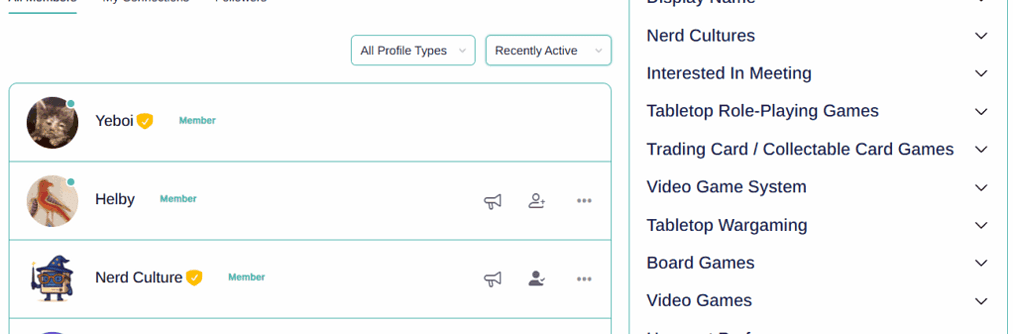
Every great online community starts with the right core members. Nerd Culture’s Member Search helps you find people who share your interests, location, and availability so you can build your community with those who get it.
Top 5 Platforms to Build Your Online Community
As mentioned previously, your platform will dictate the way your members interact. What you want to achieve, who you want to join, and how you intend to manage your community all come down to the site you use as your hub. Let’s explore the best platforms and learn how to build a community on social media.
Nerd Culture
Nerd Culture is a community-first platform designed to help connect you to the right people, not just more people. Born from a practical frustration, Nerd Culture was actualized when its founder struggled to find local tabletop groups to play with when traveling for work. “Looking for” Reddit threads weren’t helpful as they would quickly grow cold and Discord servers would often be crowded making it difficult to assemble a group. Add location-match and whether you would even get along with your crew and you’ll be searching for a needle in a haystack.
Nerd Culture’s core features solve this issue, notably its group/member search functions. Looking for a D&D group that’s in Memphis that only plays on Thursdays? Group search can filter by location, group size, and meet times. Just moved and trying to make friends in a new city? Member search can filter by availability, interests, and hobbies to eliminate the guesswork.
Gaming may seem like its focus, but you can make a community for just about anything you’re passionate about. If you’re just looking to make new friends to start and then figure out what you want a group for later, Nerd Culture can make it happen. All our groups are indexed in search engines, so people can organically find your group if it’s public.
Where Nerd Culture excels:
- Group and member search filters by location, interests, and availability
- Events calendar integrated with your communities
- Public groups are search engine indexable
- Built specifically for connection
Where Nerd Culture is developing:
- Growing platform, so some features are still maturing
- Less suited for communities that rely heavily on real-time chat or more advanced moderation tools
Strong fits for:
- All community types, particularly local-based communities
- Hobby and gaming groups
Discord
Originally built to be a voice-chat app for gaming, Discord has since transcended its origins to become the go-to platform for online social interaction. The platform contains everything you need for a comfortable online-chatting experience: real-time messaging, voice calls, even livestreaming and video calls. Discord groups or ‘servers’ can also be easily configured with dedicated voice/text channels and contain a wide variety of tools to moderate and organize communities. User-to-user interactions are the platform’s main driving force, so community members quickly develop a strong sense of belonging.
Unfortunately, Discord’s biggest weakness is that it has no real avenues for community exposure besides direct invites, so cross-channel marketing is a must. Gaming communities in particular often use platforms like GameTree as a funnel into Discord servers, but the platform functions in its own internal environment where content is not easily shareable and stays isolated. If organic traffic is important to you, there are plenty of alternatives to Discord to check out.
Where Discord excels:
- Real-time voice/text chat, livestreaming, and video calls
- Dedicated channels for server organization
- Massive toolbox for moderation
- Customizable bots to automate community needs
Where Discord suffers:
- Steep learning curve
- No real methods of exposure besides invite links
- Content is not easily indexable and difficult to keep track of
- Conversations often get buried
Strong fits for:
- Gaming and fandom
- Creator-led
- Niche interest
In the early internet days, if you were interested in any sort of hobby, you would frequent forums, ones usually built specifically for that subject. When Reddit entered the scene, they decided to consolidate the entire concept of forums into a singular social media site. Each forum or ‘subreddit’ is interconnected on Reddit’s massive network, allowing news and content to be quickly searched from every subcommunity or aggregated to be seen on the front page. Unlike traditional forums, content isn’t chronological and is ranked by community vote, allowing valuable and informative posts to float to the top.
Reddit serves as a resource hub and drives engagement through discussion and information sharing. As a result, posts are often indexed on search engines allowing for passive exposure. However, since subreddits share an ecosystem, building a following can be a slow start as opposed to communities that have a dedicated space. If you’re looking for real-time communication, Reddit does have a chat feature, but everything else functions asynchronously, so other Reddit alternatives may suit your needs better.
Where Reddit excels:
- Top-of-the-line format for knowledge/Q&A content
- Organic exposure through site’s internal search function and search engine indexing
- Subreddits can be extremely niche
- Anonymity
What Reddit suffers at:
- Difficult to expand beyond the platform
- Moderation culture can be inconsistent
- Reddit policy and algorithm changes
- Harder to make personal relationships to other users
Strong fits for:
- Gaming and entertainment communities
- Skill and learning based communities
- Niche groups
Facebook Groups
During the 2010s, Facebook was the flagship social media platform, but if you think it’s not relevant today, you’re sorely mistaken. With an enormous user-base, fine-tuned search filters, and event/group management tools, Facebook has everything you need to host an online community. It even has integration to other platforms such as Instagram and has organic ways to rank in search engines. Many people already have an account too and familiarity with their user interface, so there’s little investment or perceived risk involved in joining.
All these features give you more leeway in terms of subject matter, as you can reach a broader audience without diluting your core community. Facebook especially excels in the local community space and is one of the best places to build communities around social hobbies. From there, you can leverage the platform’s innate content posting features and invite discussions to keep users engaged and active.
However, one caveat of Facebook is its lack of anonymity. Privacy settings can help protect a user’s profile visibility, but the platform was built to be personal. This can be perceived as a double-edged sword in that more upfront profiles can give you a better idea of who you’re talking to, but that profiles can easily be catfish (fake) accounts meant to deceive you. But this is the case for any sort of social media platform, so consider reading up on how to safely meet someone online in person or virtually.
Where Facebook excels:
- Established, massive user-base
- Well-known user-interface
- Optimized group creation and search filters
- Cross-platform integration and indexable on search engines
Where Facebook suffers:
- Algorithm could deprioritize group content in main feed
- Declining engagement amongst younger audience
- Data privacy concerns
- Lack of anonymity
Strong fits for:
- Local or event-driven communities
- Lifestyle or hobby groups
Patreon/Substack
Most content creators usually make their start on a platform like Youtube or Twitch but may desire more autonomy over time. They need to offer content that people are willing to pay for while also making members feel involved. In comes Patreon and Substack, platforms dedicated to giving creators the freedom to establish their own content with a more streamlined paywall.
Patreon is a great fit for creators who wish to deliver exclusive content and have direct interaction with their dedicated audience while Substack is a strong newsletter platform for publishing posts and interacting asynchronously. Granted that you are the content creator and leader of your community, Patreon or Substack may be platforms to look into if you are currently uploading on any of the following platforms:
- YouTube
- TikTok/Instagram
- Twitter/X and BlueSky
- Podcasts
Where Patreon excels:
- Direct financial support from dedicated audience members
- Tiered memberships
- Wide array of built-in tools for posts, messaging, and feeds
Where Patreon suffers:
- Requires a pre-existing audience
- Community features are an afterthought to paywall and content delivery tools
- No avenues of organic traffic
Where Substack excels:
- Strong writing and publishing tools
- Comment sections and threads provide focused interaction in each post
- Substack network can provide organic discovery
Where Substack suffers:
- Requires a pre-existing audience
- Interaction is often writer to member instead of member-to-member
- Not designed for organic community growth that other platforms offer
Strong fits for:
- Creator-led communities
- Writers and thinkers who amass a following
Build or Find the Online Community for You
Great online community building starts with understanding what members actually want. Nerd Culture’s Group Search lets you explore active communities so you can see what works before you start your own.

Engagement and Growth Strategies to Build Your Online Community
You’ve now created your community and hit the ground running. The question now is how to build an engaged online community that sustains and grows itself over time. Growth strategies should come second to cultivating engagement and a sense of belonging. If your community is still new, try to focus on one of these at a time. The right online community engagement strategy can take your group to the next level, but consider your current membership’s needs and wants before diving in.
Focus on consistency over volume
Believing that more content is always better is a mistake many make when looking into how to grow an online community. Not only can it annoy members and come across as spammy, but it can also reduce each post’s visibility and may tank engagement. Build a schedule that gives members plenty of time to see and respond to your posts, fostering positive habits rather than relying on bursts of activity. If content quality is high, users will organically find reasons to come back.
Participation loops
Participation loops are a straightforward way to boost activity by giving users the opportunity to share in discourse. You start by asking a question or prompting a discussion, then respond to and recognize users who share thoughtful insight. Polls are a good way to spark participation to obtain community opinion with varying investment as users can simply vote and/or elaborate on their decisions in the comment section.
By asking the community for their opinions, you can engage your user base directly and maybe highlight interesting notes in a special follow-up post. You can then use this momentum to spark the next conversation. Members will feel rewarded for their output through recognition and visibility within the group, and moderators receive high-quality content to work with. It’s a win-win.
Encourage peer-to-peer interactions
Communities are not classrooms, and users shouldn’t feel as though they need to raise their hand to contribute to discussions. No group that feeds all conversation through a central authority is going to last very long. To avoid this issue, do as much as you can to encourage users to interact with each other.
This may involve creating a separate space or channel, or giving the spotlight to particular users who post helpful replies to build trust among members. Nerd Culture is a good example of a platform that can help streamline growth, with tools like discussion boards and peer-to-peer discovery that make it easy for people to interact with each other rather than routing everything through a single organizer.
Use events wisely
Some of the most popular events in online communities include:
- AMAs (ask me anything) featuring noteworthy guests
- Challenges
- Giveaways
- Community votes and polls
These all cause sharp spikes in interaction that can be difficult to sustain. An effective strategy carefully plans an event calendar to ensure a regular pattern that users come to anticipate and stick around for. AMAs and giveaways take time to organize, so you might aim for one every few months, while the rest of the weeks are punctuated by challenges and polls that prompt more interaction than regular posts do. If your group is more global, consider planning online or local events.
Cross-platform growth
Though it’s better to have one highly active space than several inactive ones, your users and potential users will likely use a range of platforms outside of your primary community hub. You might consider using other social media to promote your community or collaborating with creators or similar communities to maximize visibility that links back to your core platform.
Adjust your metrics as needed
Growth is not always linear and communities naturally go through periods of stagnation or decline. Your first instinct should always be to ensure the metrics you track measure the important aspects of your community’s health.
Metrics to pay attention to are:
- The average post and reply rates of active users
- Repeat participation rates
- Length and depth of discussions
Though new membership sign-ups may slow down, you might find that those who do join immediately feel welcome and begin engaging quickly. Raw size is only one indicator of success in online community building, so don’t always fixate on it.
Your First 30 Day Online Community Launch Plan
Your first month is about helping a small group of people get to know one another. Give them a clear reason to join, something easy to do when they arrive, and a reason to come back.
Before launch: Get the space ready
Start with a specific purpose. “A place for tabletop gamers” could mean almost anything. “A group for new D&D players looking for a monthly game” tells people whether it’s right for them. Write a short description, set a few ground rules, and prepare five conversation starters. Your first members should arrive to a space where they can see how to take part.
Week 1: Invite your first members
Personally invite five to ten people who share the group’s interest. Explain what you’re building and give them one easy first step, such as introducing themselves or answering a question. Welcome each person and start a couple of discussions. Watch for conversations between members. A few people talking to each other is a better early sign than a long list of members who never post.
Weeks 2–3: Do something together
Plan one small activity that suits your group: a game night, watch party, creative challenge, or discussion. You don’t need an elaborate event. You need something people can enjoy together and talk about afterwards. Ask what they liked and what they’d want to do again. Keep the conversation going between activities, but leave room for members to start their own threads.
Week 4: See what’s working
Look back at the month. Which questions got replies? Did new members feel welcomed? Did anyone return for a second conversation or event? Keep the formats people enjoyed, change the ones that fell flat, and plan one activity for next month. You don’t need a large group yet. If members recognize one another and look forward to meeting again, you’re building something worth growing.
Example: Starting a beginner D&D group
Say you want to bring together adults who are curious about D&D but have never played. You might invite them with:
I’m starting a beginner-friendly D&D group for people who want to try the game without learning all the rules first. We’ll meet, choose a time that works, and play a short introductory session. No experience needed—come say hello.
Once someone joins, give them an easy way into the conversation: Welcome! What name would you like us to use, and what sounds more fun to you: exploring a haunted library, solving a small-town mystery, or going on a treasure hunt?
The answers help members find common ground and give you ideas for that first session. After the game, ask what they enjoyed and whether they’d like to play again next month. That’s how a community starts to take shape: people share an experience, talk about it, and choose to return.
Common Mistakes to Avoid
Much like starting a business, creating an online community comes with no guarantees. Plenty of once-popular spaces have fallen, and even more have dispersed before they could build momentum, largely due to a lack of sustained engagement.
Why online communities fail comes down to several common mistakes in community building, including:
- A lack of purpose. Giving users no reason to interact or stick around when there are plenty of alternatives out there.
- Absent owner. Due to a lack of interest or other projects demanding their attention, a missing founder leaves the community without a sense of direction.
- Too much content, not enough interaction. While memes are funny and shareable, the web has more content than it knows what to do with. Unique interactions are substantive and keep users coming back for more.
- Audience feels diluted. When growth reaches a certain point, the community’s content and culture adapts to accommodate a broader audience. Veteran users feel unfamiliar with the changing space while newer members lack the dedication or specialized interest to engage at the same rate.
- Lax or overly restrictive moderation. Striking the right balance of oversight and autonomy is tough. Many communities implode internally over content policies they deem too demanding or not stringent enough. New, completely unaware users can sense this the second they introduce themselves.
How to Revive a Dead Online Community
An online community doesn’t exactly die, but if idle for long enough, many will look to other communities to occupy their time. Many abandoned groups will still have a few dedicated users who continue to post, or at least have those who will return at the first signs of life.
Step one: Diagnosis
Identify what went wrong in the first place. A couple reasons an online community can fail are:
- Repetitive content
- Stagnant culture
- A lack of direction or over-reliance on the founder to drive interaction
- Platform mismatch
Knowing this will give you insight and ensure you don’t fall for the same trap twice.
Step two: Revisit your purpose
Culture and interests change over time. You should ask yourself if the original mission statement still resonates with your core audience, and how it might have evolved to meet current demand. Chances are that the community may not reflect the same vision that you had previously and that’s ok.
Step three: Resuscitate your core members
Reach out to your moderators and dedicated users to request their feedback and whether they would like to return to help kick-start the community revival. If enough time has passed, some of them may have moved on and you may need to find new core members which is not necessarily a bad thing. Your community may suffer from tunnel vision and fresh perspectives can help reinvigorate your culture to a newer audience.
Step four: Relaunch
An online community isn’t a business where you just rebrand and expect people to come back from the glamour of new promises. Your diagnosis from step 1 will be crucial to how you approach reviving your online community. If your community has been dormant for an extended period of time, starting your relaunch with bang is a good idea. An event to bring back old members and to invite newer members can help integration early on. Announce your reboot on your main platform to all your members, dormant or active, and across other social media to maximize visibility.
If things have just slowed down, introducing new quality content can be a steady way to bring your audience back. Revamp your posting strategy to better reflect the feedback you received. Craft your prompts and interactions around what your users have told you they want. Keep things low-stakes to start, giving everybody a chance to chime in and to reconnect with the community.
Step five: Commit to consistency
Returning members will be skeptical that a new iteration of your community can deliver where the last one failed. This is understandable and regaining community members will be slow to start as you update your structures and systems. Remember to stay diligent and visible as the leader; if you disappear before the ball gets rolling, your community will suffer from mismanagement and will die a second greater death.
Keep in mind that you’re essentially rebuilding a community from scratch, so manage expectations accordingly.
Building an Online Community Best Practices
In order to have the best probability of success, follow this list of best practices.
- Lock in your core group early. These are users who show strong interest in your subject and help keep the community active while it’s young.
- Choose the right platform. Meet your core users where they already are or invest in a platform with robust built-in management and scaling features, ideally both.
- Perfect your onboarding ritual. Greet new users with enthusiasm, and give them all the information they need while suggesting ways they can start interacting.
- Moderate fairly. Both over and under-moderation tend to cause negative sentiment. Try to find a balance that works for your particular audience and be willing to adapt.
- Avoid treating the community as a marketing channel. Your users have already bought into the community by joining, so don’t immediately bombard them with add-ons right away.
- Focus on the long-term. You will see fluctuations in activity and membership, but don’t put too much stock in those figures solely. Put your metrics into a broader perspective by analyzing them in the context of past performance and those of other similar communities.
How to Build Your Own Community that Stands the Test of Time
The longevity of an online community boils down to quality interaction and passion. Your core users will be happy to keep posting and chatting with the same 50 like-minded individuals as long as leaders and moderators keep the feed active with engaging content. Sustainable growth will come through positive word-of-mouth, invitations, and external marketing so long as the space remains intentional and actively moderated. What separates an online community from a disconnected board of random strangers will always be passion, a united purpose, and a sense of belonging.
If you’re ready to build a community that lasts, Nerd Culture was designed specifically with that in mind. We made it easy to find those who understand your passion and who want to build something special together.