



Find the Best Virtual Tabletop for Your Gaming Needs
Find the perfect virtual tabletop simulator in 2026 to run immersive online tabletop games, connect with other players, and bring your stories to life.

Tabletop gaming has been a staple of entertainment and escapism for decades. The rise and development of tabletop role-playing games (TTRPGs) have led many players to get together and immerse themselves in these experiences, turning these games into one of the top hobbies for adults while also amassing cult followings. However, the global COVID-19 pandemic brought challenging times for traditional TTRPG gaming, as in-person player sessions became difficult to host in many regions due to lockdowns. Virtual tabletop simulators, while already in existence, became more of a necessity than a helpful tool to enable players to organize and run gaming sessions.
The platforms not only helped players host their favorite games, but also drove post-pandemic interest in online TTRPGs up by 37%. The resulting rise in popularity has led to many new virtual tabletop simulators growing onto the scene, creating more organized, immersive experiences. With so many options now available, many game masters and hosts might need to consider which platform best suits their session.
What is a virtual tabletop simulator?
A virtual tabletop simulator (VTT) is a platform that helps recreate and simulate in-person tabletop gaming experiences online, enabling multiple players to play games such as Dungeons & Dragons (D&D) remotely. They are often browser or software-based tools that offer various features to improve and streamline gameplay, such as dice rolling, map sharing, character sheet tracking and storytelling.
VTTs have risen in popularity as a solution to the challenges of organizing tabletop games, including connecting players, recording detailed information and creating a more immersive experience. While the concept has existed for over two decades, advancing technology and new functionality have enabled dungeon masters to host games more effectively. Today, VTTs are an important part of the tabletop gaming community, bringing players of D&D, Pathfinder, Cyberpunk RED and many others together. They have grown from a handful of available platforms to hundreds dedicated to specific needs, primarily to help players find each other, organize games and manage details.
Why use virtual tabletop simulators for games?
For anyone new to the space, VTTs remove much of the friction that comes when finding a new hobby, making it easier to try tabletop gaming without needing a physical group or space. VTTs have also become a valuable tool for game masters (GMs) and hosts to connect players and create a more comprehensive gaming experience. The widely available platforms across browsers and downloadable applications have significantly contributed to the tabletop gaming landscape, bringing both existing and new players online with new ways to experience their favorite games.
Many have gone on to say that VTTs are now “an integral part of how we play“. Here are the main reasons backing that claim:
- Remote play: VTTs have helped connect tabletop players worldwide, allowing hosts to conduct gaming sessions online rather than in person. The platforms have significantly expanded the community and attracted more players to tabletop gaming.
- Interactivity: Players will find that VTTs can provide a high level of interactivity through features such as chat rooms, dice rolls and map and character creation. Many platforms also offer a fully immersive 3D environment for players to explore during gameplay.
- Accessibility: Tabletop games can have complex rules, creating high barriers to entry for new players. VTTs can simplify the ruleset for players or provide a point of reference on how to play or execute actions in the game.
- Automation: VTTs can help streamline complex game actions and trivial tasks. While GMs still need a comprehensive understanding of the rules, automation on platforms can handle actions such as dice rolls, character creation, combat management and stat updates.
- Visualization: Many platforms offer new layers of visual detail, creating intricate game maps and character designs. Some modern VTTs will even provide a complete 3D world to explore, similar to open worlds found in video games.
- Organization: GMs and hosts can use VTTs to help organize games, find players with relevant skill levels and record complex details, creating expansive game worlds. Many platforms offer all-in-one solutions to host compelling tabletop games.
Find Your Seat at a Virtual Tabletop for Free
As Seen On:














12 best virtual tabletop simulators in 2026
Any player searching for VTTs that align with their gaming needs will likely yield hundreds of results. Many of these will have features specific to certain games or requirements. Still, many will fit into the most popular TTRPG titles.
We’ve compiled a list of the VTTs that we believe are best suited to the broad range of players in 2026. Find our top ten below, with the pros and cons for each.
| Platform | Price | Free option | Best for |
|---|---|---|---|
| Foundry | $50 one-time | No | Overall customization |
| Roll20 | Free, Plus $5.99/mo, Pro $10.99/mo | Yes | D&D accessibility |
| Owlbear Rodeo | Free | Yes | Simplicity |
| Fantasy Grounds | Free (licensed content extra) | Yes | 5e rules automation |
| MapTool | Free | Yes | Free, open-source |
| Beyond Tabletop | Free (donation-based) | Yes | Budget D&D 5e/Pathfinder |
| TaleSpire | Paid | No | Map visualization |
| Alchemy | Free, premium tier available | Yes | Cinematic storytelling |
| Tableplop | Free with 100MB storage | Yes | Newcomers |
| Tabletop Simulator | $19.99 one-time | No | Board games |
| Quest Portal | Free, premium available | Yes | Mobile |
| Shmeppy | $4.99/mo for GMs | Yes, for players (players free) | Minimalist maps |
12. MapTool: Free, open-source VTT
RPTools, the organization that developed several other popular free TTRPG tools, developed this VTT. MapTool is a downloadable software rather than a web-based app like Roll20 or Foundry, meaning it takes just a few minutes of effort to set up before you have your first game. You get an array of great tools in the process, including dynamic lighting, vision and the fog of war, detailed token management, and a full scripting language that allows the DM to create custom rules and macros for their campaign, all at zero cost.
Pros:
- It’s free and open source; you don’t have to pay a license fee or subscription for any of its features
- Advanced features like dynamic lighting and fog of war are built in for free
- It has very robust scripting that enables DMs who want to automate certain aspects of their game to do so
Cons:
- Because it’s a downloaded software (not a web app), users need to download and install the program and also need the Java runtime to run it
- It has advanced scripting tools that can take quite a bit of effort to master, making it have a bit of a steep learning curve compared to simpler VTTs
- Because its popularity lags behind both Roll20 and Foundry, it has a less active and much smaller community
11. Beyond Tabletop: Budget VTT for D&D 5e and Pathfinder
This free, web-based VTT platform is designed for playing both Pathfinder and D&D 5e. Rather than storing character sheets and maps on its servers, players link up their Google account and store sheets/maps directly in their own Google Drive space, meaning that storage space is basically unlimited and you can jump into sessions seamlessly from a phone, tablet, or laptop. Because it’s funded entirely by donations, there’s no paywall that will force you to upgrade to a premium account.
Pros:
- Completely free; there are no subscriptions that limit features
- Uses your own storage (on Google Drive) so space isn’t an issue
- Runs entirely in the browser, meaning you can easily run it from any web-capable device, from a phone to desktop
Cons:
- You can’t play most RPG systems, just D&D 5e and Pathfinder
- It has very few map tools; specifically, it lacks features like dynamic lighting and fog of war
- Its smaller community means that if you want to find other groups online, you’ll have fewer results to draw from
10. Shmeppy: Best VTT minimalist map creator for GMs
If you’re a GM where time is of the essence, Shmeppy might be the platform you’re looking for. The name “Shmeppy” playfully references the wet-erase battle mats that GMs have drawn on for decades. Shmeppy is bare-bones by design with a philosophy that encourages spontaneity and narrative-driven gameplay over extensive map preparation. The platform has an easy-to-use browser-based map-prepping tool for just $4.99/month for GMs, players join free via shared URL.
However, Shmeppy’s main drawback is in its minimalist design, lacking the advanced features desired in most VTTs like automations and scripting tools. If you’re planning to run a more detailed session, GMs will need to pair the platform with other tools, but anyone who wants to get maps up instantly will benefit from the platform’s speed.
Pros:
- One of the fastest tools to create and share game maps, including real-time collaboration
- Clean interface that’s easy to learn
- A great tool for game prep and sharing encounters
Cons:
- Doesn’t have the advanced feature set of a full VTT
- Limited asset libraries
- Made to pair with other platforms rather than be a standalone
9. Quest Portal: VTT for mobile
Any TTRPG player will understand that things can get complicated during campaigns when there’s a lot of information to process, especially in a virtual arena. Quest Portal aims to solve this by offering a sleek, all-in-one solution to organizing riveting tabletop games.
Where Quest Portal stands out is that the VTT excels on mobile, with a dedicated app that makes organizing games on your smartphone or tablet a breeze. However, the limitations of mobile hardware mean there are fewer intricate features typically found in PC-based VTTs, lacking items such as built-in character sheets and dynamic lighting.
Pros:
- Intuitive, responsive UX making it easy to onboard players from mobile devices
- A great tool to organize campaigns and sessions well
- All-in-one tool with integrated maps, sheets and notes
Cons:
- Still in development, so there are many feature gaps
- Generative AI features might put off some players
- Relatively smaller marketplace and mod library
8. Tabletop Simulator (TTS): Virtual board games platform
Tabletop Simulator is one of the broadest platforms for VTTs, not specifically designed for any particular game. What might detract from its appeal is that it’s not primarily designed for TTRPGs, though it includes an RPG Kit with tilesets, figurines, and GM tools. TTS is simply a physics sandbox where players can design and build their own board games and share them via Steam Workshop.
However, the toolset TTS offers lets GMs and players create just about anything. If you have the patience, you can take your wildest campaign ideas and bring them to life, hosting games with multiple players, emulating an in-person gaming session. If you’re not sure which TTRPG to build around, consider checking out our D&D alternatives article, which highlights the most popular systems players bring to platforms like this.
Pros:
- A flexible toolkit to create your own tabletop games
- Massive library of player-created games and mods to plug-and-play
- An affordable option to emulate in-person tabletop gaming ($19.99 but all players must purchase it)
Cons:
- Lacks dedicated TTRPG gaming features
- Can take a long time to create a playable game
- Clunky controls can make games a bit fidgety
7. TaleSpire: VTT for map building/visualization
If you want your TTRPG games to be all about visual flair, TaleSpire is a VTT that can add new, dynamic elements to your storytelling and gameplay. The platform delivers a complete 3D environment, transforming games into miniature-like dioramas that look and feel epic.
However, the impact of the visuals weighs heavily on other typical features found in VTTs. While there are a plethora of creation tools, TaleSpire has a distinct lack of rules automation and game management features.
Pros:
- A phenomenal choice for campaign visualization
- Collaborative worldbuilding tools
- Appealing to miniature collectors as well
Cons:
- Creating complex scenes can be time-consuming, but community-shared content can speed up prep significantly
- Large, detailed maps with many lighting effects may require more powerful hardware, though base requirements will work
- Lacks many typical game management tools like character sheets
6. Tableplop: Online tabletop simulator for newcomers
Tableplop is another minimalist, browser-based VTT that focuses on fast, smooth game creation. Many users credit the platform for its low barrier to entry, efficient campaign building, and user-friendly interface. It’s free to get started with 100MB of storage for your maps, characters, and resources, but if you need more space, there’s a modest subscription fee.
Thanks to its intuitive UX, Tableplop is considered a great entry-level platform for newer players looking to expand their horizons into the tabletop gaming community. Tableplop can help players get familiar with the basics such as maps, tokens, dice, and character sheets, but lacks the advanced features found in other VTTs.
Pros:
- A fantastic entry-level VTT option
- Easy campaign creation to get games started
- More features than some other minimalist VTTs, such as an initiative tracker and character sheets
Cons:
- Lack of advanced features like dynamic fog and an extensions ecosystem means players could quickly outgrow it
- Ongoing development (solo developer), updates depend on one person’s availability
- May not be well-suited for long, detailed campaigns due to limited storage
Find the Right Players for Your next Virtual Tabletop Quest
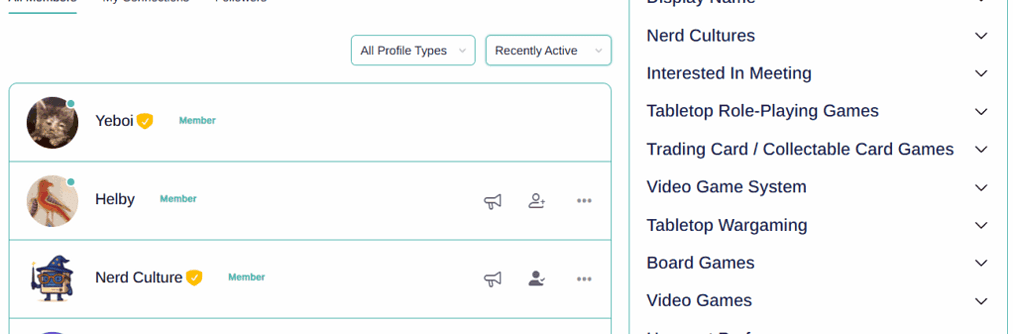
Found a VTT you love but don’t have anyone to play it with? Nerd Culture’s Member Search helps you find players to start your next adventure with.
5. Alchemy – Best Cinematic Storytelling VTT
Alchemy is a VTT that puts your story first, favoring a cinematic, narrative-driven experience over a technical detailed one. The worldbuilding tools help immerse players in their tales, keeping them engaged and eager to discover what happens next.
Alchemy’s beautiful, slick presentation makes it a fantastic option for those who prefer story-focused campaigns. However, the platform lacks deep-rule integration and automation which can make the technical aspects of gameplay more challenging. If you prefer simplicity over flexibility, Alchemy may be what you’re looking for!
Pros:
- Scene-based storytelling tools help get players immersed
- Intuitive asset management for the campaign
- Easy-to-use interface friendly to new GMs and players
Cons:
- Limited automation capabilities
- Marketplace focused more on official publisher partnerships than community-created content
4. Fantasy Grounds – Best VTT for 5e
If you play D&D and even briefly flirted with the idea of using an online tool for a tabletop RPG, it’s almost certain that you’ve heard of one of the most enduring VTT platforms on the internet, Fantasy Grounds. As of November 2025, you don’t need to pay a dime for the base Fantasy Grounds license to run the app or host games if you wish.
With Fantasy Grounds’ massive array of automation tools and features, you can create a very compelling virtual experience (especially if you run a D&D 5e game). Even better, it now won’t cost you a single dime to take advantage of the software, which remains one of the best virtual TTRPG VTTs out there. However, it’s not without its flaws. Fantasy Grounds requires a bit of study to master, so getting into the app requires a learning curve that will likely take several hours to work your way through. While the core Fantasy Grounds system rules are free with the basic app, you’ll still need to purchase the licensed rulebooks and adventure modules, which are available separately, in order to play certain published content with it.
Pros:
- Powerful automation tools for rule-heavy games like D&D 5e VTT maps
- Large marketplace for modules and licensed franchise content
- One of the best VTTs for extensive campaigns and long games
Cons:
- Costs of licenses and content can pile up
- Steep learning curve that detracts from the UX
- The application can weigh on your computer’s storage space
3. Owlbear Rodeo – Best of the Roll20 alternatives
Advertising itself as a more “bear-able” experience than other VTTs, Owlbear Rodeo offers one of the easiest and most streamlined VTTs currently on the market. Speed and simplicity are the platform’s core pillars, delivered through a simple three-stage game process: drop a map, add tokens, and play!
The minimalist, device-optimized experience sacrifices detail and features for quicker game setups. Owlbear Rodeo is a VTT you can rely on, but if you’re a player who expects heavy detail in character sheets and rule integration, it may not be the right platform for you.
Pros:
- Easy to get started and welcoming to newcomers
- On-screen drawing options help make games easy to follow
- An excellent option for those who enjoy typical human-led TTRPG play
Cons:
- Limited options for character sheets and rules integration
- No built-in marketplace; users must bring their own content from external sources
- Simpler map features than full-featured VTTs, though recent updates have added dynamic fog and lighting
2. Roll20 – Best Dungeons and Dragons (DnD) tabletop simulator
Over 15 million registered players use Roll20 virtual tabletop today, underscoring its reputation as the most popular VTT. Not limited to only Dungeons and Dragons, many GMs prefer to host virtual tabletop games on the platform because of its browser-based accessibility, user-friendliness, and extensive marketplace.
Roll20’s toolset and macros make hosting and finding digital tabletop D&D games simpler than any other platform. However, long-term players may face performance and storage limits that require them to pay significant subscription fees with no permanent license options.
Pros:
- Browser-based, making the platform accessible to a wide range of players
- One of the largest marketplaces for adventures, maps, and tokens
- Built-in game browser helps players find suitable games more easily
Cons:
- Performance dips with detailed and dynamic maps
- More subscription based due to minimal free storage
- Interface and user experience (UX) can oftentimes feel buggy
1. Foundry – Best VTT overall
We’ve listed Foundry as the best overall VTT because it offers what so many GMs desire when setting up their games: complete control over game creation and a high level of immersion.
For dedicated TTRPG online players, the one-time license fee to host unlimited games will be very appealing compared to a monthly/yearly subscription. Despite the dynamism and detailed game environments that Foundry offers, getting the VTT running can be a frustrating and complex setup process.
Pros:
- One of the most customizable VTTs available, with plenty of game options
- Offers a more immersive game environment with dynamic lighting and collision detection
- Clean user interface post setup, with extensive customization options via modules
Cons:
- Set up can take some time and can be a complicated process
- Some PCs may struggle to run games if said games are asset heavy
- GMs will need their own computer or server to run games
Find your Virtual Tabletop Group, Fast
No matter which tabletop simulator you choose, Nerd Culture can help you find your next crew with its group search, online or near you.
How do I find the best online tabletop game?
There are plenty of VTTs available, underlining how many hosts there are for online tabletop games today. Many platforms are dedicated to a specific game, while others offer broad integration capabilities across multiple franchises.
However, the number of VTTs doesn’t address obstacles such as finding players of your own skill level to play your desired game with or even one of the biggest challenges for most players today: availability. Learning how to make time for hobbies also often comes down to flexibility and picking the right tabletop game can make it easier to fit a session into a busy schedule. Some platforms are equipped with functions to help you host or find a tabletop gaming party that can accommodate both skill level and scheduling. In contrast, others may organize or discover games through Discord, Reddit, or platforms like GameTree. If you’re specifically looking for a professional GM running paid sessions, it’s worth comparing a few StartPlaying alternatives to see what fits your group and budget. If time and scheduling is an issue or you just haven’t found a full group yet, consider checking out our solo DnD guide for tips on how to play a TTRPG independently.
If you’re looking to connect with communities around your favorite tabletop games, consider checking out Nerd Culture! Whether you’re trying to find a D&D group or people who match your skill level and schedule, we’re here to guide you on your journey!
Enhance your favorite tabletop game with a VTT
Imagination, storytelling and strategy have always been integral parts of the tabletop gaming experience. Sharing these proficiencies in person between players has defined the TTRPG sessions that fans have come to know and love.
While in-person TTRPG sessions continue to thrive, VTTs offer new ways to enhance and expand tabletop gaming. They help with visualization, management, and organization, opening up popular games to new fans and giving existing fans new channels to enjoy each session.
No matter where you are in your tabletop journey, VTTs can become an invaluable asset in your gaming career. If finding the right people to play with is still the missing piece, sites like Reddit built around hobby communities are worth exploring too and we’d put Nerd Culture at the top of that list.
Turn your next campaign into a real party!
FAQs for finding the best virtual tabletop platform
What is the best free virtual tabletop?
Owlbear Rodeo and Roll20 both offer strong free tiers. Owlbear Rodeo is the simpler, faster option for shared maps and tokens, while Roll20’s free tier includes character sheets, a marketplace, and built-in player search.
What’s the difference between Roll20 and Foundry VTT?
Roll20 runs in your browser with a free tier and paid subscriptions for advanced features. Foundry is a one-time $50 purchase you self-host or pay to host elsewhere, with deeper customization and no recurring fees once you own it.
What’s the best VTT for Dungeons & Dragons?
Fantasy Grounds is built specifically around D&D 5e automation and is now free to use, while Roll20 remains the most widely used platform for finding D&D groups and official content. Which one is better for you depends on whether you prioritize automation or accessibility.